


by Dr. Sarah Treanor Bois, PhD
Director of Research & Conservation at the Linda Loring Nature Foundation
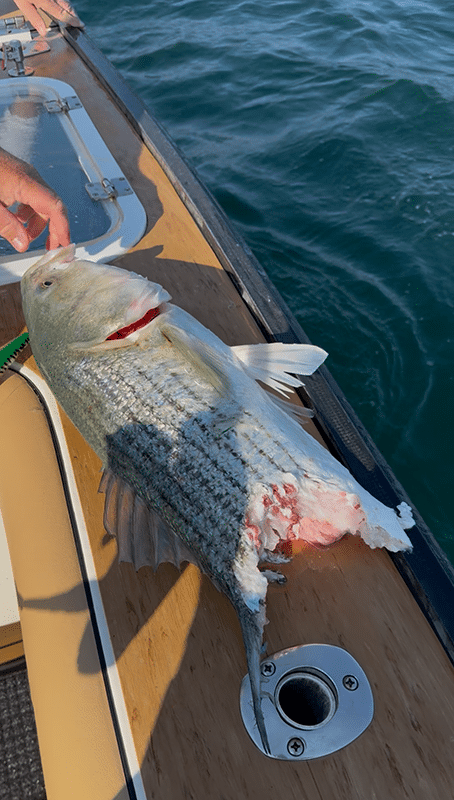
As a plant ecologist I usually write about the flora and fauna of Nantucket by land. However, I happen to be married to a fisherman. Sometimes I see or hear about something, and it makes me want to learn more. This past weekend, while on a fishing charter, my husband’s client had an unexpected surprise when reeling in a striped bass. Something “big” suddenly tugged on the line. What seemed like a decent-sized bass at first turned into a heavy haul pulling out line demonstrative of something much larger. Just then, maybe 20 feet from the stern of the boat, an 8-foot shark leapt into the air, striper in its jaws. One half of the striper did eventually make it into the boat, but the talk of the crew that day was all about the “giant” shark that trailed them and even came close enough for some great videos. The shark, it turns out, was a porbeagle. Apparently, at least four other boats had similar porbeagle encounters that weekend as humans and sharks “battled” for the available stripers. A common, but exciting sight when fishing offshore.
This encounter got me thinking a lot about porbeagle. To the untrained eye (like me) I would have yelled “great white!” Porbeagle sharks (Lamna nasus) do resemble their great white cousins, but they have a whole different ecology all to themselves. First off, porbeagle sharks are the only shark species that inhabit Massachusetts waters year-round, thriving in the cold, nutrient-rich coastal zones. They are our year-rounders! Great whites get all the attention, but they are more like Nantucket seasonal visitors: the great whites migrate to our summer waters following food (seals) and temperature. The porbeagle don’t target marine mammals like the larger sharks do. They tend to go for other, smaller fish; squid, bony fishes, and even smaller sharks. And, in case you’re wondering, because of its fish-diet, porbeagle shark attacks on humans are extremely rare.
Porbeagle are also occasionally called “Fako” because they are sometimes mistaken for mako sharks – aka “Fake Mako.” The porbeagle is a species of mackerel shark distributed widely in the cold and temperate marine waters of the North Atlantic. Gray above and white below, the porbeagle has a very stout midsection that tapers towards the long, pointed snout and the narrow base of the tail. They grow up to about 8 feet on average (12 feet max).
One cool trait is the porbeagle’s ability to thermoregulate. Like other members of the mackerel shark family, the porbeagle has the ability to maintain its body temperature above ambient water temperature by as much at 10 degrees. This is an unusual trait among fishes, possessed by only a few other fast-swimming fish, like tunas. This ability is an important adaptation to the cold waters that the porbeagle prefers and allows them to be a very fast-swimming predator.
In addition to being fast, the porbeagle is highly active. It can be solitary or found in groups. They are also one of the few species known to perform seemingly playful behavior. They have been observed in groups of up to 20 individuals tossing about floating objects, including driftwood and seaweed. They seem to engage in such activity for no apparent reason other than to kill time! The fishermen I asked hadn’t seen any of the playful behavior. They mostly talked about porbeagles being either cool to fish for or annoying. In the past, when population abundances were higher, porbeagles were often considered a nuisance because of the damage they often caused to light fishing gear. Even now, they can break lines, steal fish (like the striped bass), or they get in the way of fishermen targeting tuna.
Porbeagle have some of the same diet as bluefin tuna, and so they are often found in the same waters. From a tuna fisherman’s perspective, they can be a nuisance, breaking off leaders and hooks. But it can be awesome for a charter to have that experience. As the charter guys will attest, it’s always fun with clients to see, especially if it’s their first time seeing a shark up close and not in an aquarium!
The porbeagle shark is listed as “Near Threatened” throughout its range and as “Vulnerable” in the northeast Atlantic Ocean. Porbeagle stocks in the North Atlantic were seriously depleted due to overfishing during the latter half of the twentieth century. Because they are exceptionally slow-growing and produce few pups per litter, porbeagle are vulnerable to overexploitation.
Protections in recent decades have allowed some recovery to the populations and recreational fishing is allowed for the species, though highly regulated. Around Nantucket, porbeagle are considered locally more abundant. Fishing for porbeagles is strictly regulated by the Massachusetts Division of Marine Fisheries and NOAA, and a federal Highly Migratory Species fishing permit is required. If you ever catch a shark that you are unable to identify, please remember to follow this guidance from NOAA Fisheries: “If you don’t know, let it go.” Some look-alike species have very different levels of protection. The full list of Permitted and Prohibited sharks can be found on DMF’s recreational fishing limit website: mass.gov/info-details/recreational-saltwater-fishing-regulations.
If you are fishing and see any sharks, try to snap a photo and add them to iNaturalist (inaturalist.org). Observations by recreational boaters and anglers alike help keep track of populations and provide valuable data to state and federal regulators.
The porbeagle seen off of Topspin Charters last week ultimately swam away with half a striped bass in its belly. But the tales of those on board will last a lifetime.
