

by Suzanne Daub
Artist David Hostetler would have turned 100 this December. He isn’t here to celebrate, but his wife, Susan Hostetler, is making sure the milestone is marked by sharing his work and honoring his dedication to helping people see that every aspect of life is art.
In the Hostetler Gallery on Centre Street, Susan is presenting David Hostetler: Forest & Form. “He was an American artist doing an American art form,” Susan explained. “This year is a way to showcase his diverse body of work.” She’s hosting special talks with wine tastings every week, showing sculptures never before on display from a private collection, and screening The Last Dance, the biopic that won four Emmy Awards.
David once said with his characteristic wit: “I was born in 1926 in Beach City, where there was no beach, and there was no city, and there certainly wasn’t any art. The only art I knew in my life was a guy named Art up on Main Street: I think he was a plumber.” He was an only child of a high school principal and a stay-at-home mom. “There was no enlightenment in that environment,” Susan explained. “He was a quirky, clever kid… an only child who was an astute student of his environment… drawn to the beauty of the land.”
David’s grandfather was an Amish farmer, and his influence on his grandson went beyond agriculture. For a time, young David actually considered becoming a farmer himself. “But his buddies said stick to what you know…the art,” said Susan. He never forgot the lesson his grandfather’s world had taught him, though: an appreciation for purity, for humble simplicity, for a way of life stripped down to its essentials. Decades later those instincts would define his sculpture.
According to his biography David L. Hostetler The Carver (c.1992 by Ohio University College of Fine Arts), he first became interested in art at age 18 while recovering in hospital from a serious shrapnel wound received while training for a stint in the US Army. “Those were the first drawings I ever did, the first art of any sort…And I really dug it, really got turned on,” he’s quoted as saying.
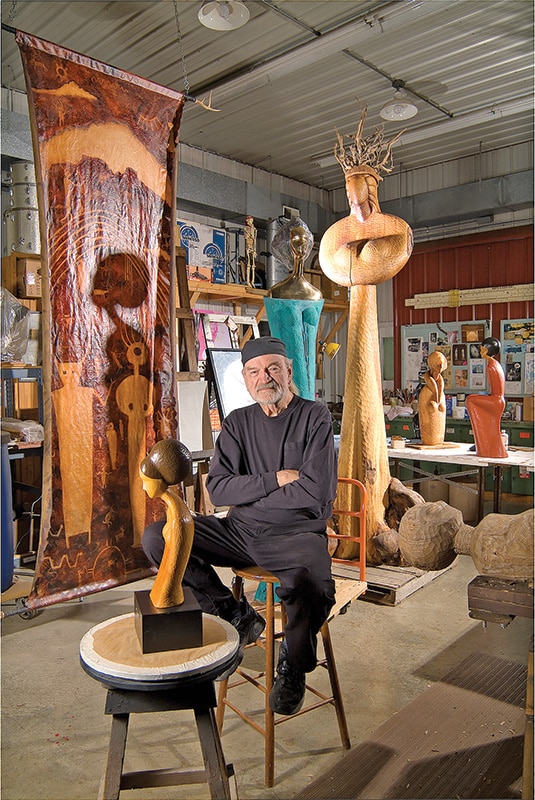
When he got to college, the world of art opened to David. “He couldn’t get enough of it,” Susan said with fondness. It was painting at first, then ceramics— functional pottery: the practical, everyday objects of a working potter. “But he was hungry for everything.” He went on to earn his degree from Indiana University in 1948 and a Master of Fine Arts from Ohio University in 1949: the beginning of a relationship with that university that would define nearly four decades of his life.
During his many years as a professor and a mentor at Ohio University, David was always encouraging his students, always seeking something new, and finding art in all aspects of life. In the 1970s, he started Art Park with two other professors on 40 acres in Athens, Ohio: envisioned as a place where students and artists could work in nature and have gatherings with art and music.
Hostetler retired from teaching in 1985, earning the title of Professor Emeritus. He was, by every account, disciplined and relentlessly driven: teaching by day, then heading straight out to the studio to carve. “Sleep,” Susan said, “was never a big deal to him. He was Mr. Scholar at all times: gregarious, humble, endlessly curious, always chasing something new, and always pushing his students to chase it with him.”
According to Susan, his most prized award was Professor of the Year, “because it was about his teaching…he really wanted to help students see that every aspect of life is art…I still hear from his students. I just met a woman over text who was David’s TA, and she wanted to bring her daughter and granddaughter to the studio to see his art.”
Long before he was well-known as a sculptor, David loved music. He played drums in his high school band, then in a jazz band, and he kept it up through college. In the 1990s, he turned back to the drums, becoming a fixture of the Athens jazz scene. In 1999, he built his own intimate venue in his Coolville Ridge studio — Club Dave started as a jam session spot for friends who love the music and became a cultural hotspot.
David knew that he’d never become a famous jazz musician. But art was different. He knew he could make a name for himself with his art. Music and art were both his passions, but Susan said “his most joyful state was carving.”
During his early years of teaching, Hostetler also owned and operated a ceramics studio. By the late 1940s, his pottery was evolving into something more sculptural. Around the same time, he picked up a side job helping an antique dealer restore furniture— it was there, sanding and repairing old wood, that he fell in love with the material that would define his career.
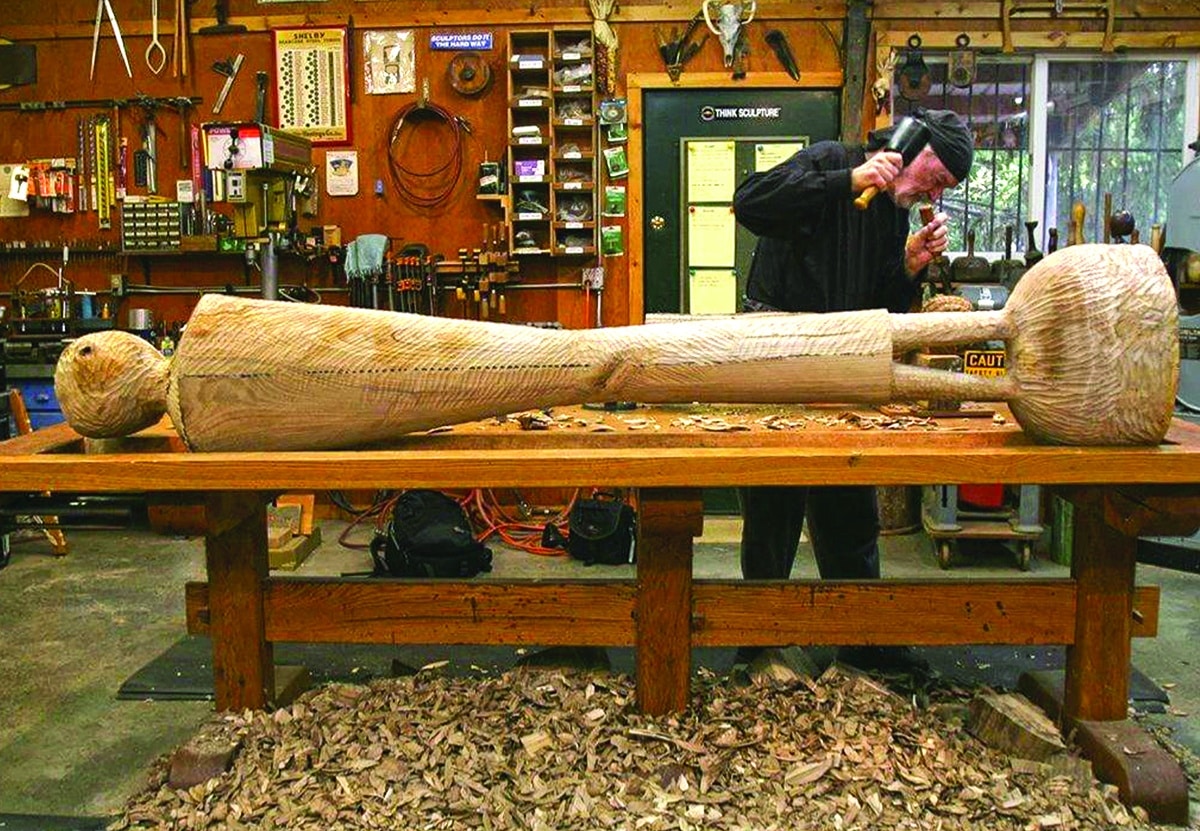
Hostetler worked in native hardwoods—elm, cherry, walnut, white oak, maple, catalpa—and later in exotic species like purpleheart, ziricote, lacewood, and tamarind. Wood, he believed, wasn’t just a passive material: it had a say in the outcome. In the Emmy-award winning documentary The Last Dance, he explains “The tree has its own idea of where it’s gonna go. And so it will be partially me and partially the tree talking to each other throughout this process of carving.” As Susan puts it: “the wood sometimes dictated the sculpture.” His process itself was almost primitive: a log on a bench, a mallet, a gouge, and hours of patient work, one stroke at a time. “Carving is a very simple act,” Susan says. “David’s sculpture is complicated in its simplicity.”
His full-figure sculpture Blue Bathing Suit, carved in the 1960s, marked the real beginning of the body of work he’d for which he would become known and his dedication to his primary subject: women. His earliest carvings nodded openly to his Amish upbringing and to American folk art: by the second half of the 1960s, his forms had grown more stylized, more distilled.
In an artist statement, David explained: “My sculpture is woman with the mark of the present and the past cultures on her. Timeless woman as an object, a goddess, angular, sensual, stylized; but always filled with grace and vitality that is woman. Woman to me is the ideal form, erotic yet pure, compositionally variable, yet identical every time…
“…Among all goddesses, Asherah is my inspiration, for it is she who was carved from living trees as well as the image of the tree of life. This goddess is the embodiment of my passion for wood and all that is woman.
“I want to resurrect the Goddess Asherah and the goddess within all of us through my art. The goddess is a symbol of empowerment for woman that men will not resent or fear for it is a metaphor for earth as a living organism, an archetype for a balanced feminine consciousness that encompasses men and women as equals. Maybe this is a search for the strength of women in all of us.”
His American Woman Series from the 1960s earned him national prominence for his graceful, flowing wood sculptures with their simplified forms such as Yellow Dress (1965). He initiated this series using indigenous hardwoods, then progressed from folk images to stylized symbols in exotic woods. These pieces from this specific time in David’s ouvre are very distinct in comparison to his later pieces, which exude modernity in all their sleek, slender forms, like Sensuous Woman.
“Any artist who sees the female figure: sees it is complicated. David was trying to distill the forms to get to the essence of feminity,” Susan added. “His female form evolved: ‘how do I simply, simplify, yet still show the female form.’ Some are powerful; some are soft and gentle. Most of his work exudes strength and confidence and a quiet spiritualism.”
David first came to Nantucket in 1970, following a woman. They married on Nantucket, but after a few years that relationship ended.
“It was love at first sight. He fell out of love with the girl and fell in love with the island,” said Susan. David showed his work in the Lobster Trap Gallery, with dealer Reggie Levine, and at Peterson Gallery, before operating a shared gallery with Tom Mielko. In 1983, David opened his own gallery on-island, which has operated seasonally ever since.
In 1985, he was introduced to Susan, and they spent thirty years together. Susan came from a traditional home, and remembers deciding almost instantly that she wanted to marry him. But it took David some time before he stepped into another marriage.
“It wasn’t until wife number three that I really focused on my lover,” he explained in The Last Dance. “She became my model; she became a very specific point in my life, in my studio because she was in love with art”
A favorite memory of Susan’s is of the two of them sitting at the dinner table: “he would enlighten me about art… he was always curious and always teaching: I carry that with me still…He was very gregarious but humble and curious. He made a mark on so many people: he was always the professor seeking something new.”
One of Hostetler’s most recognized work of art is The Duo, his stunning sculpture in bronze of two intertwined figures that stands in New York City next to Trump Tower, selected by renowned architect Philip Johnson and commissioned by Donald Trump. “That is us,” Susan explained.
David loved Nantucket: surfcasting at Nobadeer, clamming, scalloping, long conversations with fellow artist Kerry Hallam. He bought land whenever he could, and even carried trees from Ohio to plant on the island. One of his best-known later works, Nantucket Goddess, was carved from an elm that had to come down on the island, “the Coffin Tree.” He was, she says, always on the lookout for a Nantucket tree to carve.
Hostetler’s work now sits in more than 25 museums and public collections, including the Museum of Fine Arts in Boston, a milestone Susan describes as a genuine turning point in his career. Installation of The Duo in Manhattan brought him a wave of national attention. On Nantucket, his work can be found not only in the gallery but throughout the community — at Greydon House, the Nantucket Inn, Nantucket Cottage Hospital, and the Artists Association of Nantucket, and on several private properties.
Asked what she hopes people will still be saying about David a hundred years from now, Susan comes back to what made him rare even in his own lifetime: he was a direct woodcarver, a vanishing art using a log, a bench, a mallet, a gouge: “There are so few of them now…He took a log, put it on a bench and carved it by hand one gouge at time,” Susan explained. There was nothing between the artist and his material but time and patience. Out of that process, he carved himself a permanent place in American art.
Susan still isn’t tired of any of it. “I’m never bored selling his work. I love revisiting it all…I love meeting new people. It’s very joyful.” A century after his birth, people still walk into the Hostetler Gallery and say the same thing, unprompted: “I’ve always wanted a Hostetler.”
David Hostetler: Forest & Form continues through the season at the Hostetler Gallery, 42 Centre Street. Learn more at DavidHostetler.com.

