


by Dr. Sarah Treanor Bois, PhD
Director of Research & Conservation at the Linda Loring Nature Foundation
Turkey vultures are one of my favorite birds. I generally have a soft spot for the disparaged and underappreciated. However, for turkey vultures, my love for them comes down more to how they are perfectly suited for their actions: structure suits function. These beautiful (yeah, I said “beautiful”) birds are highly specialized. Their “naked” head is free of feathers, causing some to malign these majestic creatures for their wrinkly pink heads (the original skin heads). A head free of feathers allows this bird to feed on carrion without pesky feathers getting in the way or becoming contaminated.
So, while they may be unattractive to some and get a bad reputation, turkey vultures are quite gentle creatures that await the death of another creature before making a meal.
In addition to providing an important ecosystem service by eating carrion across the island, we can also add “climate opportunist” to the list of turkey vulture attributes.
In the early 20th century, the turkey vulture’s range didn’t extend beyond New Jersey, although stragglers were occasionally spotted farther north. Those along the east coast were typically partial migrants—breeding in the Northeast and moving south toward Florida or the Gulf Coast for the winter. However, because of warmer boreal winters, they are increasingly ditching migration altogether. Areas that used to host them only in the spring and summer are rapidly gaining permanent, year-round resident populations.
Turkey vultures nested in Massachusetts for the first time in 1954, and now they are firmly established in the state as both breeding birds and migrants. On Nantucket, turkey vultures used to be a rare occurrence. They would make the occasional Christmas Bird Count and were listed as a rarity in the 1979 Checklist of Nantucket Birds by Edith Andrews and Ken Blackshaw. Their range had been expanding across Massachusetts and in the late 1990s, a rumor began to circulate about a nest somewhere on-island, possibly in Madaket. Since then, turkey vulture populations have been steadily increasing on the Cape and Islands: a sign of warming weather patterns and available habitat. Flash forward to 2026, and we not only have a breeding population, but we also have a year-round resident population of turkey vultures.
Turkey vultures are now considered climate beneficiaries. Instead of f leeing poor habitats and unsuitable climate, they are actively expanding their geographic range northward and staying in northern regions longer due to warming winter temperatures. Milder winters allow them to push deeper into northern states like Maine, Vermont, and even parts of Canada, where they were once rarely seen. Rather than losing habitat, turkey vultures are rapidly widening their footprint. Research published in The Wilson Journal of Ornithology projects that the turkey vulture’s global breeding range could more than double by 2070 under future climate scenarios.
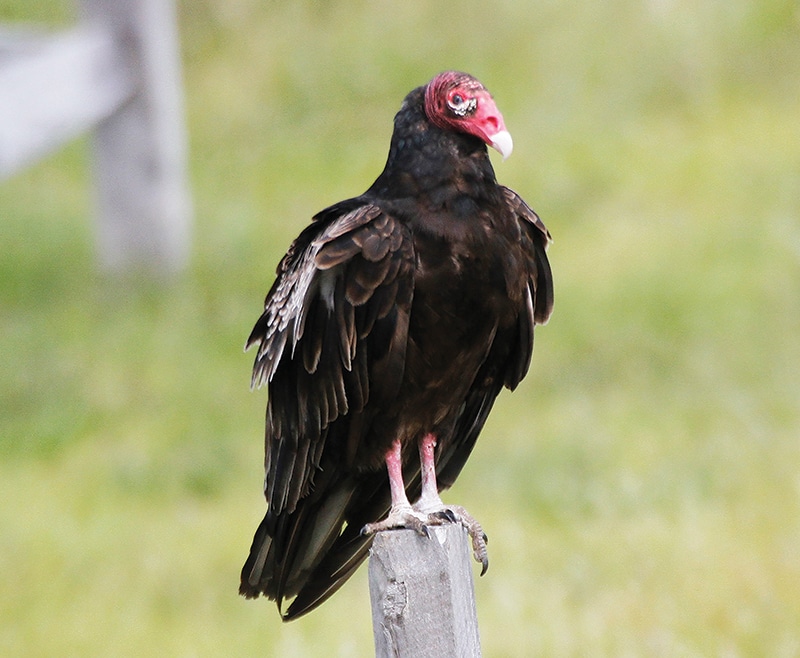
Warmer temperatures not only make it easier for vultures to handle winter at higher latitudes, they also create more thermal uplifts for vultures to use for soaring. This decreases the amount of energy vultures need to soar long distances in search of meals, which also might be smellier and easier to detect with warmer weather. Variation is key to the adaptability of species and their ability to survive changes to the climate and habitats. Turkey vultures are certainly one of the more resilient of birds.
Turkey vultures can easily be distinguished from other soaring birds because of their distinctive “V” shape in the sky. Ungainly on the ground, they are graceful on the wing. They can frequently be seen soaring high above, wings outstretched, rarely beating their wings as they keep an eye to the ground for carrion. Yes, turkey vultures eat dead things. Not just any dead thing. Turkey vultures seek out fresh dead animals such as rabbits, deer, other birds, and even fish. Their palate does not discriminate by species. Because of this specialization, turkey vultures are performing an important ecosystem service. They are a natural clean-up crew. Imagine what would happen throughout Nantucket’s conservation properties is no animal ever made use of these deceased creatures.
What does this mean for the island? In short, it means that Nantucket roadways and open spaces are now a whole lot cleaner. Turkey vultures are carrion feeders and, thus, do us all a favor by consuming our roadkill and other decaying wildlife. As they say, one birds trash is another’s treasure…
If you’re lucky enough to find their roost tree, you will note that multiple vultures will roost in the same tree at night (outside of the breeding season). One such dead snag over by the dump on Madaket Road has been host to several turkey vultures recently. They have been visible sunning themselves in the morning sunrise. Unlike other birds, turkey vultures are not early risers. They spread their wings while perched to warm up their wings for flight, taking off in mid-morning. While they may white-wash the area surrounding a roost, without a syrinx (bird voice box) it is not as noisy a place as one might think. Their vocalizations relegated to grunts and hisses.
Vultures are a relatively understudied and underappreciated raptor, yet they provide a crucial ecosystem service by removing carcasses from the land. Noticing changes to vulture populations early can help ensure that these efficient scavengers remain in the skies. Our most common species can act as telltales for environmental change, if we pay attention.
