


by Dr. Sarah Treanor Bois, PhD
Director of Research & Conservation at the Linda Loring Nature Foundation
Nantucket is a place of tradition, a location where time seems to stand still. Just walk down Main Street and you can be transported 150 years. For most, it’s the architecture that is reminiscent of the past. However, one of my favorite examples of this is with our street trees.
Walk down almost any cobbled street in Nantucket’s historic district and you will move through a green tunnel. Overhead, the arching branches of American elms (Ulmus americana) knit together into a canopy that cools the pavement and softens the light. It’s not just a beautiful scene, but a surviving fragment of a landscape that once defined American towns and has vanished from nearly all of them.
The American elm earned its place in the nineteenth-century imagination through form. Its trunk rises straight and divides into a vase of limbs that sweep upward and outward, leaving a high, open crown that shades a roadway without blocking it. This form is what gave the elm its “broccoli tree” reputation. The species is also very tough. It tolerates compacted soil, road salt, wind and the stresses of urban life—perfect for a busy downtown. Those traits made it the default street tree of the Northeast. By the late 1800s, elm-lined main streets were a civic ideal, a sign that a community expected to endure.
Nantucket’s elms are tied to disaster. After the great fire of 1846 (which burned most of downtown), the island planted a new generation of American elms along nearly every street and at every corner. Rebuilding after the fire meant more than replacing buildings. Planting trees was part of the recovery, a way to re-establish order and pride in a scorched town. Those saplings, planted around 1846-1850, are now roughly 175 years old, which makes them elders in a species that rarely sees such ages anymore.
The reason today’s Nantucket elms are remarkable is a fungus known as Dutch elm disease. It spreads from sick trees to healthy ones by elm bark beetles and also underground through root grafts between neighboring trees. Dutch Elm Disease reached North America in the early twentieth century. Elms set in tidy rows often fuse their roots, so one infection can pass down a whole avenue like a fuse. The disease has killed at least 43 million American elms in cities and forests, and some estimates run higher. By the late 1980s, most large American elms had died. Whole towns lost their canopies within a few seasons.
On Nantucket, the disease was a little slower to arrive, giving us time to learn from others. Dutch Elm disease was first reported on Nantucket in 1958. At the time, 80% of the shade trees on Nantucket were elms, so a careful watch over the trees had been maintained since the inception of the Tree Commission in 1948.
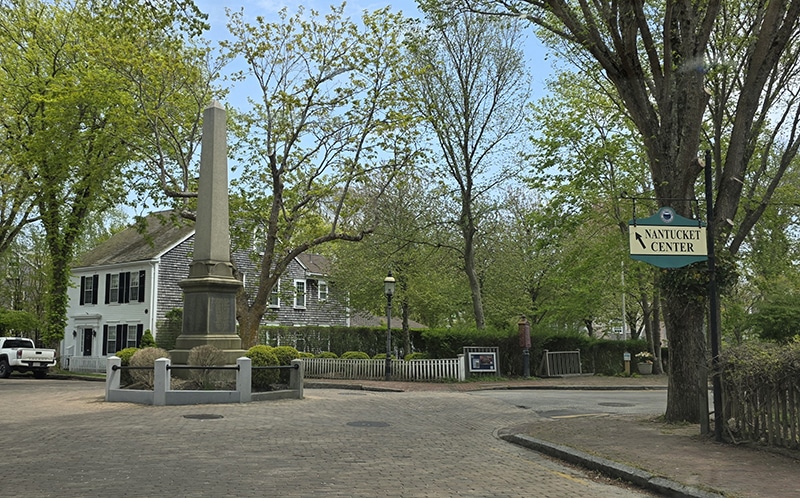
After learning from other communities, Nantucketers knew what to look for and how to respond. In 1980, 30 elm trees growing in around the downtown streets, including many lining Main Street, had to be removed. According to David Champoux, the town’s Assistant Tree Warden at the time, the dead and infected trees had to come down immediately. When the beetle moves to a new tree, it starts by feeding on small twigs in the upper part of the tree and lays its eggs in dead or dying elm wood. A diseased tree will show signs of yellowing at its upper branches. Soon, those branches start to wilt.
To save and replant the island’s signature canopy, local organizations like the Nantucket Tree Fund partnered with the town and youth groups on public education, disease management, and new plantings. In 1994, the Nantucket Garden Club helped fund the “Johnny Elmseed” program in connection with the Boy Scouts for the planting of 150 disease-resistant elm trees on the island. The “Johnny Elmseed” program was a nationwide grassroots reforestation initiative launched by the Elm Research Institute and the Boy Scouts of America to restore American elm trees. The initiative centered on planting the American Liberty Elm, a patented cultivar developed through institute-supported research that was bred to resist Dutch elm disease.
Local Boy Scout troops planted the young saplings in community nursery plots and tended them for two to three years until they reached six to eight feet in height. Once the trees were strong enough, Scouts were to transplant them into public spaces like parks and along city streets. I don’t know the fate of the Nantucket elm tree nursery plots, but maybe some of them were used to replace older elms that were lost.
Overall, the Johnny Elmseed program demonstrated strong public enthusiasm for bringing back iconic elm-lined streets, but had mixed survival success nationwide. Today, arborists and the USDA recommend planting newer, thoroughly tested cultivars.
Today, Nantucket is home to one of the largest populations of old-growth elms that survived Dutch elm disease anywhere in the northeastern United States. The reasons are probably a mix of geography and effort. Thirty miles of open water offers some insulation against the beetles that carry the fungus, and the island’s long tradition of watchful tree care did the rest. Early detection, prompt removal of infected wood and sanitation of dead material are the standard defenses, and they work best in a small, closely managed community where someone is looking at every tree.
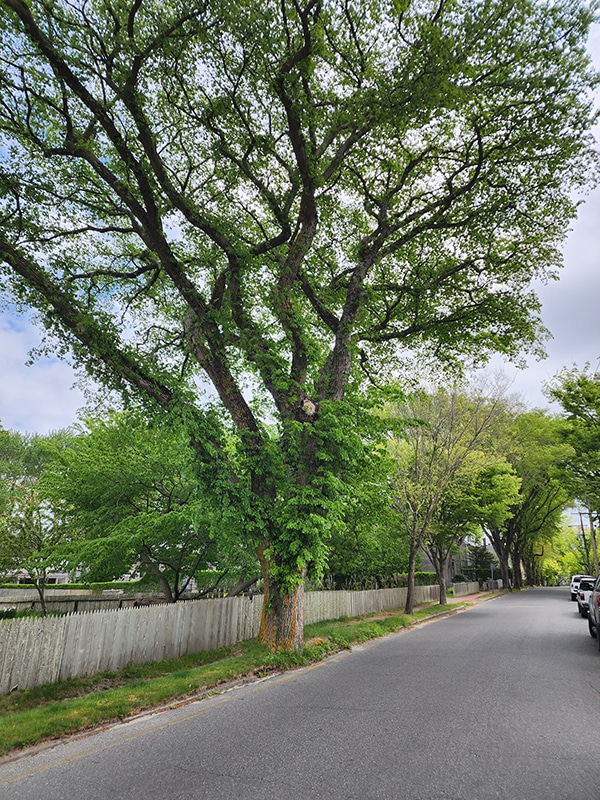
Nantucket’s elms are known individually, the way old people in a small town are. The town arborist, Dale Gary, has named three that are especially dear to him: a large specimen on Quince Street, one in the back corner of the Academy Hill parking lot, and the massive elm at Four Corners near the high school. Gary has spent years working to keep the island’s most historic trees alive, treating them as patients rather than infrastructure.
The trees are not immortal, and the losses are felt. One of the island’s oldest elms came down in high winds and heavy rain at the Silver Street parking lot in 2024. A tree that has stood through a century and a half of nor’easters can still be undone by one more, especially once age has hollowed its heartwood. Each fall is a reminder that preserving a landscape means managing its succession as well as defending its elders.
An old elm is far more than a pretty object. Its broad crown intercepts heavy rain and slows runoff, and in summer it lowers the temperature of the street beneath it. Its bark, furrowed and deeply ridged with age, shelters lichens and invertebrates, and its high limbs give nesting sites to songbirds. It’s also amazing to think of what that tree has witnessed—150 years of Nantucket comings and goings. If only those trees could talk!
In a place as exposed as Nantucket, where salt wind and sandy soil are constants, a mature shade tree is also a statement of resilience. The elms’ presence says something about the soils beneath the old town and the shelter of the buildings around them.
For Nantucket, the lesson runs in both directions. The island holds a rare living reference collection of what American streets once looked like, and it holds genetic material that scientists value. It also faces the plain arithmetic of age: trees planted after 1846 will not last forever, and the next generation has to be planted, tended and protected now. The 1846 planters understood this. They put in trees they would never see mature, for a town they hoped would outlast them.
One of my favorite trees, the “broccoli tree” at 4-corners by the high school, was recently awarded a Liberty Tree designation, placing it among a select group of historic trees recognized for their cultural and civic significance. It’s wonderful to see a celebration around a tree! I am reminded of the story of the giving tree; much loved and also taken for granted.
