


By Suzanne Daub
Tucked away on our small island 30 miles off the coast of Massachusetts, one of the most consequential craft preservation programs in the country is carrying on traditions that stretch back centuries. The Heritage Craft program, operated by the Nantucket Historical Association, is making Nantucket a focal point for the preservation of a variety of traditional crafts. Drawing students from the local community and from across the globe, the program offers a rare and immersive opportunity to learn from master practitioners, ensuring that the skills, knowledge, and cultural memory embedded in these crafts are passed on to a new generation. In a world that moves faster every year, Nantucket is a place where time slows down enough to remember treasured handmade traditions.
This January, the Nantucket Historical Association announced that its beloved Decorative Arts program was getting a new name. The change from Decorative Arts to Heritage Craft might seem slight. But for Mary Lacoursiere, the program’s artistic director and the driving force behind it for the past two decades, it was a moment of clarity several years in the making.
“We are not changing what we are doing,” Lacoursiere explained, “We are calling the program what it actually is.”
The rebranding began during a conversation on paper marbling about a year ago, when Lacoursiere was told that hand marbling is considered an endangered craft, even appearing on the UK’s Heritage Crafts Red List of Endangered Crafts. “Not knowing what that was, I did a deep dive into what that meant,” she explained. “The Red List is a UK list and is part of the Kings Trust…the focus is on artisan traditions and keeping those disciplines alive and thriving. [The Red List] categorizes the crafts from extinct, critically endangered up to viable…When I looked at their list, a large portion of workshops we have offered for the last 20 years is on that list.”
What Lacoursiere found changed the way she thought about her own program. The Red List doesn’t just measure a craft’s popularity: it measures the risk of traditional, skill-based crafts dying out, ranking them by their likelihood to survive for the next generation. It evaluates crafts based on the availability of practitioners, training opportunities, and market viability, providing a comprehensive assessment of intangible cultural heritage. A craft can have thousands of enthusiastic hobbyists and still be in serious danger of disappearing.
The Nantucket lightship basket is a good example. NHA’s basket classes are offered year-round and consistently sell out: “the craft is popular because of the history, the story telling around this craft, and the pure pleasure of making your first or 40th basket.” But the number of basket makers who support themselves financially by doing it has dwindled sharply. “Years ago there were many Nantucket basket makers making a good living, all with waiting lists for their work,” explained Lacoursiere. “Now there are only a few makers left making a living at this craft…If the US had a Red List,” she added, “I feel Nantucket baskets would be on it.”
The NHA has been offering hands-on craft workshops for more than two decades from a campus at 4 Mill Street in the building known as the 1800 House. Classes included lightship basket weaving, scrimshaw, silversmithing, glass blowing, calligraphy, printmaking, shell art, fish printing, and more. The program has always been grounded in Nantucket’s artisan history. What Lacoursiere and her team now realize is the larger significance of what they have been teaching.
“We did not realize the bigger implication and the importance of what we were building. We just focused on what we knew was important. It has been an organic evolution over time, and we have built a place where historic craft can be learned, celebrated, and passed on.”
NHA Gosnell Executive Director Niles Parker framed the relaunch in similar terms. “Mary and the incredible instructors we have been fortunate to work with have been stewards of this important work for many years,” he said in the program’s official announcement. “It’s time for us to showcase it and share it with a broader audience to preserve these art forms for generations to come.”
In April of 2025, the NHA membership approved acquisition of 91 Bartlett
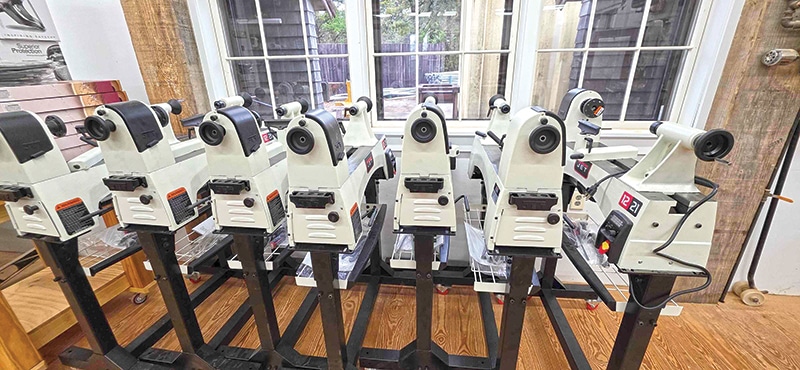
Road. In addition to key long-term operational benefits, critical space for upgraded artifact handling, treatment rooms, digitization workstations, and betterdesigned s,ltorage solutions, the property also had a move-in ready, first-class workshop. The workshop and additional space have become a second location for the NHA’s Heritage Craft classes, particularly those that require large specialized equipment.
This year, Heritage Craft is offering more than 100 different workshops—a number that keeps climbing as Lacoursiere continues to add new teachers and classes. The program draws students locally, from the mainland, from across the US, and there are even some students who travel internationally to take these classes. As of this writing, 40 of those classes are already sold out.
The workshop calendar at nha.org includes a range of handicrafts: needlework, scrimshaw, penwork, calligraphy, transferware, metalsmithing, bandboxes, letterpress, sailors’ valentines, decorative papers, and lightship baskets from the classic round basket to bangle bracelets, woodturning, decorative engraving, blacksmithing, bronze casting, and paper marbling.
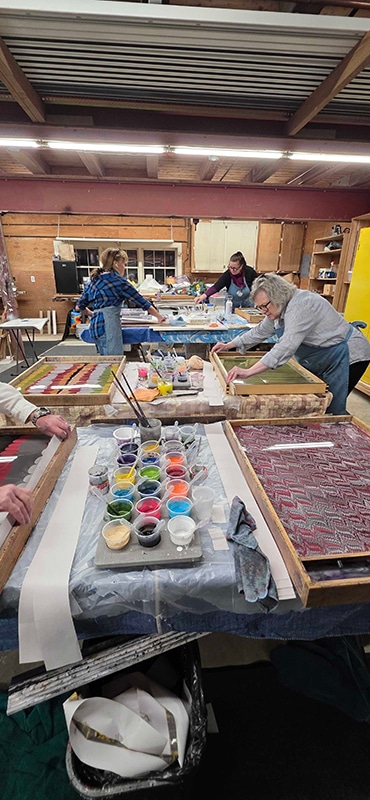
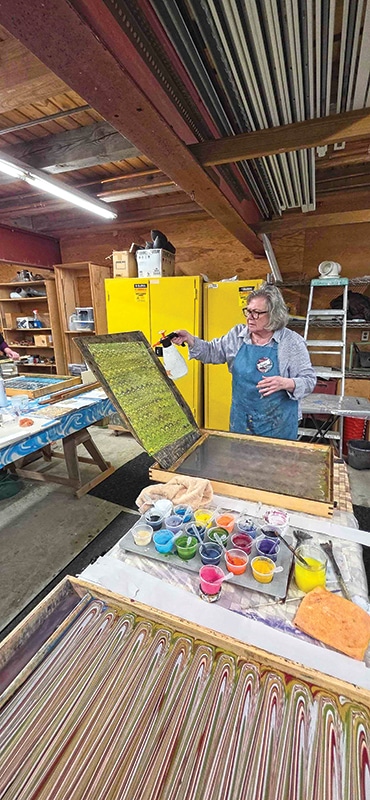
That last discipline has become one of the more popular Heritage Craft sessions. The first 2026 marbling sessions—two classes, each running three full days from 9 am to 4 pm—sold out within 24 hours of being announced, drawing students far and wide. Each class accommodated 10 to 12 students, who by the end produce up to 80 distinct marbled papers.
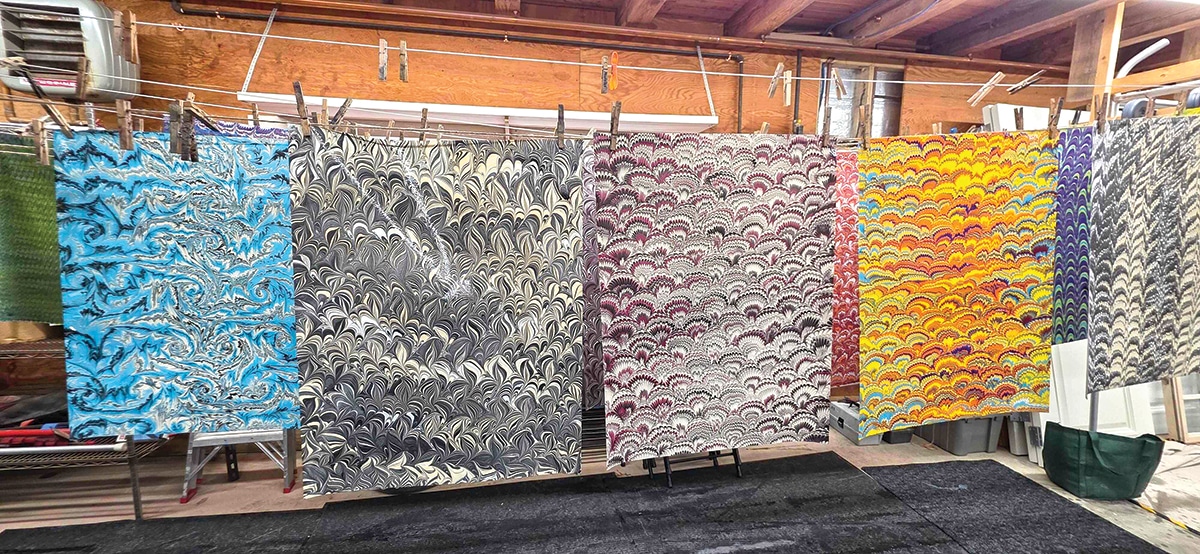
The talented instructors for these classes were Dan and Regina St. John of Chena River Marblers, who have been practicing and teaching the art for decades, including at prestigious craft schools such as Snow Farm: The New England Craft Program, North Bennet Street School, and the John C. Campbell Folk School. These renowned instructors have a mission to keep hand marbling alive. “This is a craft that people don’t recognize…we take them on a journey…our mission is to get people who want to carry it on…it’s addictive,” Regina commented. And they welcome students with a range of experience: “Come see us—it’s a lot of understanding the chemistry and fluid dynamics. Marbling is all problem solving. There’s a reason something is not working: we help figure out the problems.”
Lacoursiere, who first managed to get into one of the St. John’s popular classes in April 2024 after years of trying, has become devoted to the discipline. She is planning to study with them again in Turkey this autumn.
“I bring in high-level teachers who have widespread followings,” Lacoursiere explained. That commitment to excellence extends across the Heritage Craft roster: sculptor and RISD professor Doug Borkman teaches bronze casting; wood-turner Eric Goodson leads bowl-turning workshops; and master Nantucket basket maker Kathleen Myers teaches weaving of Nantucket lightship baskets.
In addition to teaching those who are pursuing an avocation, Lacoursiere also hopes to offer career paths and continuing ed for professionals. She commented on the challenges of pursuing a craft as a career: “Artists have always found a way to have many streams of income to make it all work. But I think it may matter more now with our culture slipping in ways that are not what we would like. What we do [at NHA Heritage Craft] and will continue to do is hire those artisans to teach, promote their work, and sell their wares. The thing we will do now, with more intention, is to expand some of our offerings to provide learning opportunities for professionals to gain additional skills and knowledge that they can use in their own practice and teaching.”
As part of NHA’s Heritage Craft, this September Master Basketweaver Myers will guide a small group of participants through a three-day lightship basket workshop aboard the Nantucket Lightship LV-112, docked in Boston Harbor. The idea is to return the basket to its origins: the craft was first developed by sailors stationed for years on the lightships that marked Nantucket’s treacherous shoals, who wove to pass the endless hours at sea.
It is exactly the kind of “destination class” that Lacoursiere sees as part of Heritage Craft’s future: immersive and place-based. Additional destination classes offered this fall include a Nantucket Windsor Chair Making Workshop in West Sussex, UK, and Embroidery and Textile Arts with the Royal School of Needlework in London.
Not every craft experience can happen on a lightship, of course, and not everyone can travel to Nantucket or to the UK, so the NHA Heritage Craft also has online classes. Free workshops are online and premium paid courses that include mail-home kits with materials are offered to make the most popular workshops accessible to anyone, anywhere.
The newest online project now in the pipeline is a complete Nantucket lightship basket course, developed in collaboration with Kathleen Myers. “There is no online class where you can learn this tradition start to finish,” Lacoursiere explained. “We worked with Master Basketmaker Kathleen Myers to execute this workshop and are really proud of the result. It will be a basket that both beginner and experienced weavers will want to do as it’s a beauty!”
The online model also serves a preservation purpose that goes beyond the lessons. “You can document and transmit knowledge that is learned through hands, not books,” Lacoursiere explains. Once people have tried a craft in person, kits and video instruction help them continue the practice. “I find that once people have tried a new craft, they want another project that helps cement the information: and they begin an ongoing practice.”
Beyond the individual workshops, something has evolved at the 1800 House over the years that goes beyond class enrollment. Heritage Craft has become a gathering place where craftspeople share not just techniques but knowledge, problem-solving, and community.
“Craft Gam has become a place where people really share their skills with one another,” Lacoursiere says, referencing the program’s frequent informal gathering sessions. “People may come in with a problem that everyone there can help with. A real sharing of knowledge: that has been one of our strengths.”
Heritage Craft classes are structured to be accessible to all skill levels. Even beginning students leave with sophisticated, creative work; more experienced practitioners find they can take the same class to a higher level. The off-season classes are growing in popularity among Nantucket’s year-round residents. Grant funding and other support may help make those workshops more affordable to locals. Some classes, including basket weaving, welcome young adults from age 10 and older.
During the summer, the NHA’s Heritage Craft programs become a destination drawing visitors who specifically come to the island to spend a weekend making something beautiful and learning something rare.
The NHA has also worked to try to ensure that in-demand workshops don’t simply leave people out. “When possible, we often add sections when a class sells out,” Lacoursiere notes. “And we offer private group classes. We try to accommodate students.”
Whether the current surge of interest in handmade craft is a temporary cultural moment or something more lasting is a question Lacoursiere has clearly thought about. When asked, she replied without hesitation: “Lasting.” Her reasons circle back to the same forces that gave Heritage Craft its name. People are recognizing the importance of knowledge and disciplines that must be taught, practiced, and passed on by human hands. Artificial intelligence is reshaping the economy in ways that make skills that cannot be automated more valuable, not less. And there is something about handicrafts—the concentration they demand, the community around the craft, the object it produces—that addresses human needs no algorithm can meet.
“We’ve been here offering this the whole time,” Lacoursiere says, “and did not even know it.”
The Red List revealed what the program already was: saving what is at risk of being lost. The new name, Heritage Craft, simply says it plainly.
For the current schedule and to register for a class or workshop, visit nha.org.
