

by Dr. Sarah Treanor Bois, PhD
Director of Research & Conservation at the Linda Loring Nature Foundation
Nantucket is home to many rare plant species, but few bear its name. Nantucket Shadbush (Amelanchier nantucketensis) is a globally-rare shrub that was once thought to be limited to our island. This small shrub named after our island, is locally abundant. This woody plant is also found on Cape Cod, Long Island, and other coastal locations along the Atlantic coastal plain.
That’s right: even on Martha’s Vineyard, this plant is called Nantucket Shadbush.
Until 2011, Nantucket Shadbush was listed as a species of “Special Concern” in Massachusetts, under the Massachusetts Endangered Species Act. While it is still considered uncommon throughout much of its range, additional plant records have led to the removal of its “Special Concern” status. It still remains rare in the northeast, and the island is likely home to some of the largest and healthiest populations.
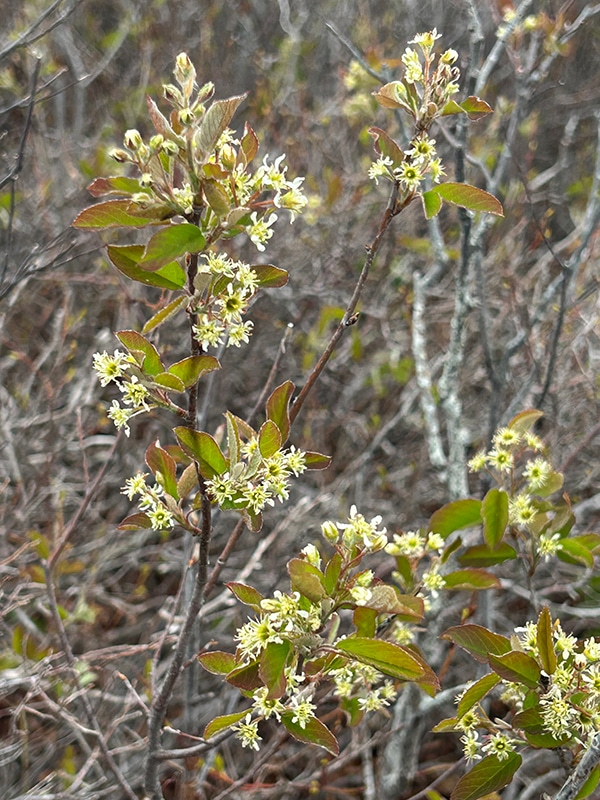
The “Nantucket” part of the name comes from the fact that it was first described by botanist Eugene Bicknell after he collected specimens on Nantucket. The name “shadbush” comes from the plant’s coincidental blooming with the historical running of the shad (a local fish species). There are other shadbushes with similar flowering times. The Nantucket Shadbush, however, is locally the dominant shadbush.
The small, white flowers of our shadbush would be unremarkable later in spring and summer. Blooming first, before leafing out and before the showy blossoms of summer, gives this plant a special place as a harbinger of the show of flowers to come. It typically blooms in May-early June, producing cream-colored flowers with spoon-shaped petals. The unassuming flowers help distinguish this shadbush from its close relatives. Its pollen is sometimes born along the petals’ edges, rather than on anthers, which is a very rare plant trait: a phenomenon known as andropetaly.
Like the island it is named for, Nantucket Shadbush flowers are smaller and much more understated than the showier, tall forms of Amelanchier. I like to think of them as demure and classy; lovely and delicate without the need for garish attention.
The small white Nantucket Shadbush blooms are said to signal the running of the shad (fish migration into estuaries around the island). It also signals the thawing of the soil – ready for spring planting. This type of nature’s synchronous timing is known as “coincidental phenology.” The various events aren’t reliant on each other, but their timing has evolved to coincide.
Unlike other shadbush species, Nantucket Shadbush is a low-growing deciduous, clonal shrub. It propagates itself mainly by sending up new stems from the root stock, rather than by producing seed. This is why you will find it in dense patches rather than individual solo plants. The more tree-like shadbushes (Amelanchier laevis and Amelanchier candensis) are also found throughout the island. Fun fact for identification is that they sometimes hybridize and can vary in local microsites. But that is to be teased out another day.
One thing I love about Nantucket Shadbush are its leaves. They are not the showiest part of the plant, but the fuzzy underside of the ovate leaves can give it a blue-gray look overall. The red stems and woolylooking leaves have a lovely effect in spring.
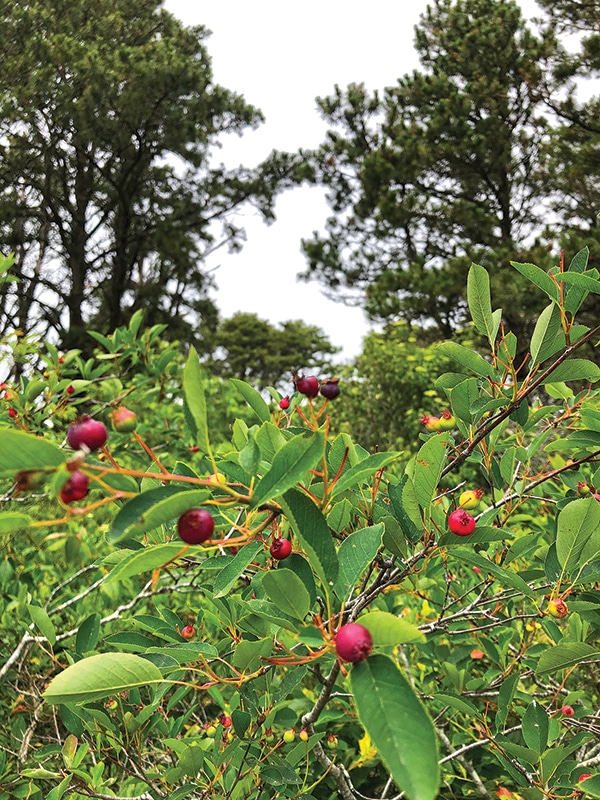
Shadbushes as a group have many common names. I have been told that if a plant has many common names, it has been useful to people in many different areas over time. Shadbush, serviceberry, sugarplum, Juneberry… all are common names for the same type of plant. Nantucket Juneberry (shadbush) may help you remember when it will be in fruit. By June the fruit of the shadbush (known as a pome) will ripen to a dark red, almost purple, like a large blueberry. The fruit are edible to humans and are quite delicious. However, you have to beat the plethora of wildlife that also feast on shadbush. Nantucket Shadbush produces a small number of fruit overall. They are more of a snacking fruit than anything you could use to make a pie or muffins. The actual flavor can vary year to year depending on moisture content during maturation. With our continued drought conditions on Nantucket, I wonder how this year’s crop will taste.
Now is really the time to appreciate the shadbush. Once peak growing season hits and the fruits have vanished, the shadbush, in full leaf, seems to fade into the general flora where other plants are much showier. It will be later in fall when, again, the shadbush has some notoriety. That is when the leaves turn a bright red-orange once again letting us know they are there.
To see Nantucket Shadbush for yourself, head to the outwash plains of the south shore and along the bike paths of Madaket and Miacomet. Nantucket Shadbush likes some level of disturbance (often in the form of management). Therefore, it can be found locally in our early successional habitats and along bike paths that are infrequently mowed. Nantucket’s early successional grasslands and heathlands are core habitat for this species and a great place to start. Dionis area and the Nantucket Land Bank property between Eel Point Road and Madaket Road (Trott’s Hills) are good spots to view this plant.
