

by Dr. Sarah Treanor Bois, PhD
Director of Research & Conservation at the Linda Loring Nature Foundation
This week we’re all about fireworks on-island. We jockey for the best spot and hope the fog that typically coats the Gray Lady takes a break for the festivities. If you look a little closer at the edges of fields and forests this time of year, you might be treated to your own personal light show in nature. We’re talking about fireflies!
A week or so ago I was sitting on my back deck looking out onto a small patch of conservation land past my backyard. I spotted a few quick flashes right at dusk, and I yelled, “Fireflies!” For me, it was the first of the season, but I have since heard that some people have been seeing them for a few weeks already. Such a treat.
It’s been a while since I’ve seen them. Lat year we had only a few, and I chalked it up to me not spending as much time on the deck during the evening. However, fireflies (or “lighting bugs” in some parts of the country) prefer moist, warm soil. And in this dry, drought summer, we may just be seeing fewer of them.
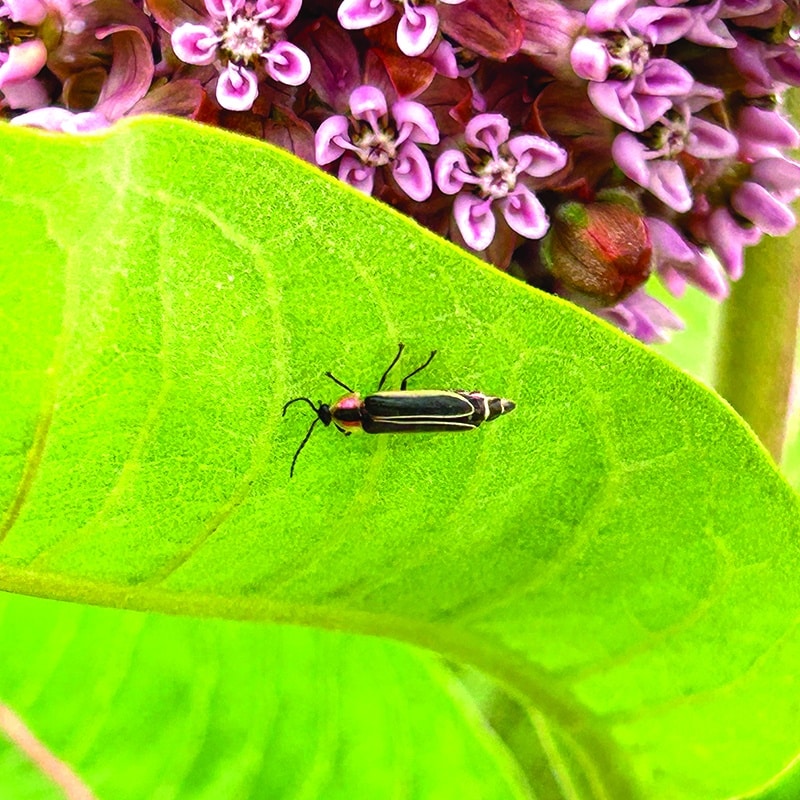
Fireflies are actually bioluminescent beetles rather than true bugs. Fireflies and lightning bugs are common names for a family of beetles called Lampyridae. There are actually more than 150 species of fireflies in North America, and more than 2,000 worldwide. They generally divide into three groups based on how they attract mates. There are those that blink in quick flashes, those with long, slow glows, and those that don’t use light at all, but communicate by other means such as pheromones (chemical signals).
For the “blinkers,” each species “blinks” in a specific pattern, like Morse code to communicate with others of the same species. At this time of year, they are looking for mates, with the males flying around at dusk flashing specific patterns to attract females. It’s a dramatic love-dance with the firefly abdomen aglow as he searches for a mate. The females, meanwhile, rest on vegetation and generally do not fly. When she sees a male of her own species flashing the correct pattern, she flashes back. In this way, females have their choice of mates. If she doesn’t flash back, he cannot find her. She can literally “throw shade”!
How do they do it? The glow is actually a chemical reaction known as bioluminescence. The lightning bug controls the reaction, and thus the pattern, via its light organ. The release of oxygen controls the reaction, so in the presence of oxygen and other necessary chemicals, the abdomen lights up. Without oxygen, there is no light.
There are about 15 species of Photinus fireflies in New England. They are small and produce a yellow-green flash. The Pyractomena fireflies are about the same size but produce an amber flash that looks like a campfire ember. The Photuris fireflies are bigger (about an inch long) with a green flash. Massachusetts Audubon’s Firefly Watch Program has a great infographic to help you determine which type of firefly you have based on the light you see.
In some parts of the world, fireflies will blink in unison as a group. This is famously seen with tropical fireflies in Southeast Asia. It has also been seen in the Great Smoky Mountains, where people gather every year to see the show. Imagine seeing a sea of fireflies blinking green all in unison! Researchers are not positive about why this happens, but the main hypothesis is that they are attracting mates as a group rather than individually.
Fireflies are associated with summer in New England as this is their mating season and is the best time to see them. On Nantucket, they typically appear during late June and early July. While it’s difficult to pinpoint the exact date fireflies will appear each year, researchers know that temperature and precipitation have something to do with it. Fireflies love hot and humid weather. We haven’t had much precipitation lately, but when we do, the hot humid air resulting can lead to a spectacular firefly show. It’s one consolation for humidity!
Weather not only plays a role in how soon you’ll see lightning bug flashes but how many flashes, too. On warm and humid evenings, it’ll be like a firefly disco party with lots of flashes. Conversely, on cooler nights, when air temperatures take a dip into the 50s, it may take longer to see even a single flash. Why is this? Fireflies, like most insects, are cold-blooded (they depend on heat from their surrounding environment to help them function), so their activity peaks when temperatures rise and slows when temperatures drop.
Researchers have found that the numbers of fireflies are declining globally, and there are a few reasons why. First: there are fewer places for fireflies to live because of habitat loss primarily due to development. Fireflies need marshes and meadows to live in and illuminate. This could also be a climate change effect.
Fireflies also need darkness to light up and find love, because bioluminescence is needed for reproduction. Males attract mates with their glowing butts. They need darkness to signal each other. Dark skies are diminishing especially in highly populated areas in the northeast. Nantucket’s dark skies initiative, Nantucket Lights, works to preserve our dark nights.
The use of broad-spectrum pesticides creates additional challenge for the glowing insects. Adults only survive for a few weeks, just enough time to mate. They spend most of their time in the ground as larvae eating slugs and snails before coming out of the ground and lighting up. Pesticides soaking into the ground take a toll.
Fireflies around your yard are not only a fabulous evening light show, they help control other insect pests. As larvae, they are predatory and eat other insects, snails, and worms. As adults, they may eat other insects but mainly feed on plant nectar. To attract fireflies (and other beneficial insects) to your yard, limit or restrict pesticides as well as the wattage of outside light.
Because lightning bugs communicate with light, please don’t shine flashlights or other bright lights near them. It will confuse them and interfere with their nightly routine and possibly their mating chances!
It’s best to observe lightning bugs just after dusk. With a little practice, you can learn to recognize many fireflies by their flash patterns. To learn more about fireflies in Massachusetts or other areas of the US, check out the Xerces Society’s Firefly Atlas: fireflyatlas.org. This project collects species-level data on the distribution and seasonal timing of fireflies. You can add your observations and learn more about our lightning bugs.
And while I am always an advocate for collecting more data, don’t forget to enjoy the summer magic of fireflies!

