


by Shawn Roberts
For most of the day, Nantucket moves surprisingly fast. Contractors race between job sites, restaurant staff hustle through double shifts, and delivery trucks bounce down cobblestone streets. Cyclists pedal furiously toward beaches, brunch reservations, and ferry departures, while tourists clutch maps, trying to squeeze every possible experience into a single week they spent eleven months looking forward to. Summer arrives with a kind of beautiful urgency. Everybody is headed somewhere.
Then something strange happens around seven o’clock.
The island begins to slow down.
You can almost feel the shift. Cars start drifting west toward Madaket, beach chairs appear in the backs of trucks, and coolers get loaded. Families gather children who have spent the day collecting enough sand to build a small nation. Somewhere, somebody is picking up takeout; somewhere else, somebody is opening a bottle of wine. The migration begins. And for reasons nobody fully understands, thousands of people who spent the entire day rushing suddenly become willing to sit perfectly still.
All for a sunset.
I’ve always loved that about Nantucket. Not just the sunsets themselves, although they are undeniably beautiful, but the fact that so many different kinds of people gather together to watch them.
In almost every other part of life, people separate themselves by age, income, profession, politics, and social circles, but a sunset doesn’t seem particularly interested in any of that. At Madaket, Dionis, Steps Beach, Eel Point, or any number of places where the island leans into the western sky, those distinctions begin to blur.
The hedge fund manager sits in a beach chair next to a carpenter covered in sawdust. The family staying in a waterfront estate watches the same sky as the kid working two jobs to afford rent. Locals, tourists, summer people, washashores, and first-time visitors all end up facing the same direction: toward the horizon. For ten or fifteen minutes, nobody has better seats than anybody else. The sky belongs equally to everyone.
I think that’s part of what makes it feel so important. Modern life gives us very few shared experiences anymore. Most of us live inside carefully customized worlds, split by different news sources, social media feeds, and schedules. We no longer watch the same shows or gather around the same events the way previous generations did. Yet somehow, every evening, the entire island agrees that something worth seeing is about to happen.
So people show up. Children chase one another through the dunes, and teenagers pretend they aren’t interested while secretly taking photographs. Couples sit shoulder-to-shoulder in folding chairs, old friends tell stories they have already told each other a hundred times before, and dogs wander hopefully from blanket to blanket searching for dropped sandwiches.
Then gradually, conversation begins to soften. Not stop, just soften. Because even the most talkative people eventually run out of things to say when confronted with a sky doing something extraordinary.
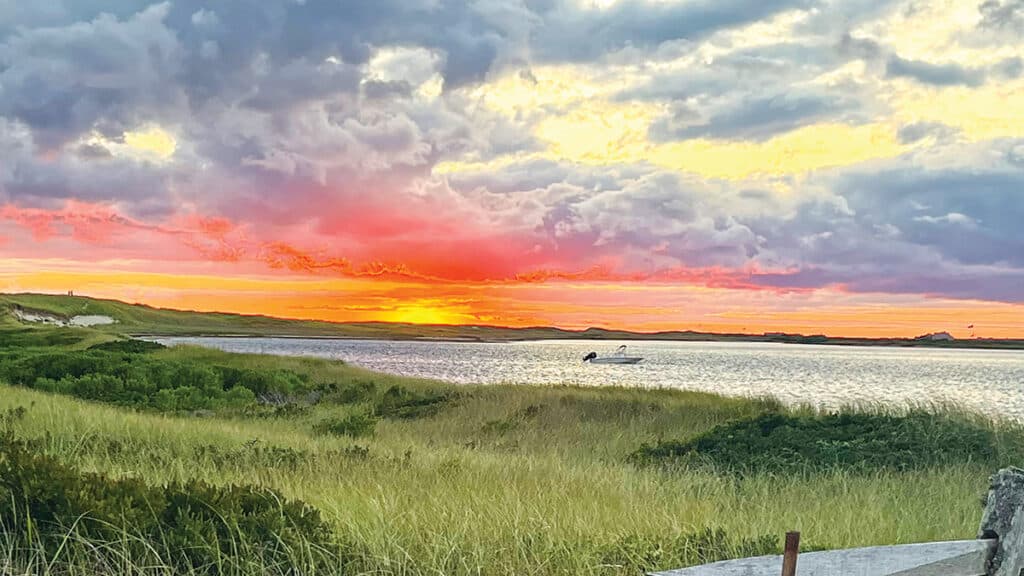
The colors never arrive exactly the same way twice. Sometimes the sunset burns orange and gold so intensely it feels theatrical. Other evenings, the sky settles into soft pinks and muted purples that seem almost too delicate to notice at first. Occasionally, fog rolls across the horizon and transforms everything into watercolor. The Atlantic is an artist with an unpredictable mood, and Nantucket has learned not to expect consistency from artists.
What I love most, though, is the anticipation. The waiting. The shared understanding that something beautiful is coming, even if nobody knows exactly what form it will take.
That feels increasingly rare today. We live in a culture obsessed with immediate gratification where every question receives an instant answer and every moment of waiting is instantly filled with phones, notifications, and distractions. Yet every evening on Nantucket, people voluntarily sit and do absolutely nothing for twenty minutes. They watch the sky. That’s it. No productivity, no achievement, no transaction. Just attention.
Maybe that’s why it feels so restorative. The sunset asks nothing from us except presence. You don’t need money, credentials, local status, or insider knowledge to enjoy it. Nobody checks your bank account before allowing you to admire the horizon. You simply show up, and the island does the rest.
I sometimes wonder how many important life moments have happened during these Nantucket sunsets. How many marriage proposals, how many reconciliations, how many difficult conversations softened by the sound of waves and the realization that life is shorter than we pretend. How many children sat beside parents they would someday miss desperately? How many old friends unknowingly shared one of their final summers together? The sunset never announces those moments, it simply provides the backdrop. Like all the best things in life, it works quietly.
The older I get, the more I suspect these evenings are beautiful not because of the colors, but because they gather people. They create a temporary community. For a few minutes every evening, thousands of strangers agree to stop chasing whatever comes next and appreciate exactly where they are. That’s not really about sunsets. That’s about gratitude.
Nantucket has always been a place that rewards attention. The island reveals itself slowly to those who are willing to wait. The longer you stay, the more you notice: the smell of beach roses after a humid afternoon, the way fog changes sound, the silver-gray color cedar shingles earn after decades of weather, and the particular angle of late-day sunlight on the moors.
The sunset may be the island’s simplest lesson.
Pay attention.
This won’t last forever.
Summer won’t.
Youth won’t.
The people you love won’t.
The colors arrive. They fade. The stars come out. Tomorrow the whole process begins again. And somehow that doesn’t make it sad. It makes it precious.
Maybe that’s why nobody rushes a Nantucket sunset. Because deep down, everybody understands what they’re really watching. Not just the end of a day, but a gentle reminder that the best parts of life cannot be hurried.
Only noticed.