



by Dr. Sarah Treanor Bois, PhD
Director of Research & Conservation at the Linda Loring Nature Foundation
Did you know that there once was a tree that spiked an economic bubble in the US? And there are Nantucket ties with a legacy that we can still see (and visit) on the island today?
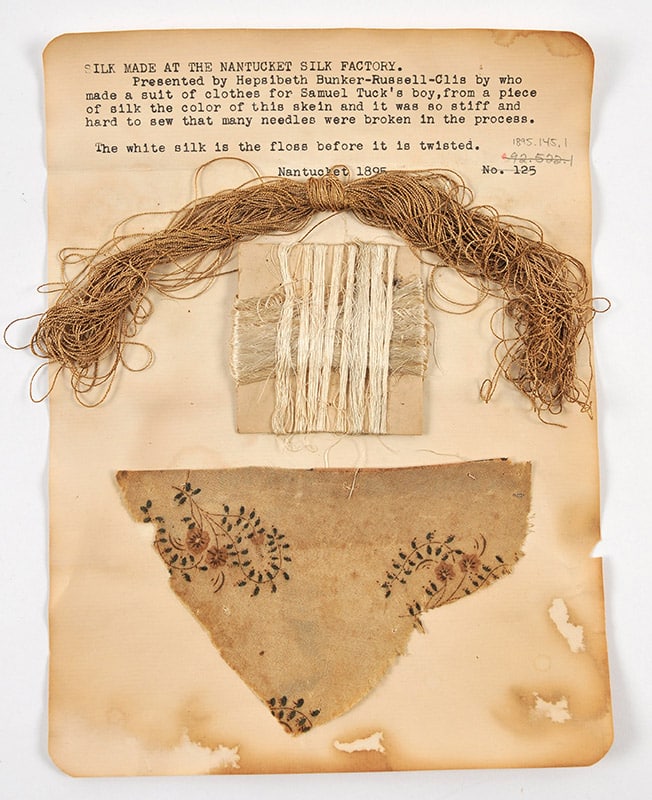
I love any story with a tree at the center—this one sparks an economic revolution! It all began in the 1830s. New Bedford was taking over as the leader in the whaling industry and Nantucket was looking to diversify. Like many others on the east coast, they started looking at silk. In the 18th and early 19th centuries, silk was a popular and highly valuable commodity. Silk fashion was all the rage but difficult to produce and expensive to import from overseas. Speculation began about whether silk could be produced in the eastern US.
In the 1830s, enterprising individuals sought investors to help start the US silk industry. But it wasn’t just factories and labor that were needed: silkworms were needed to produce the silk threads and their food source needed to be in ready supply.
Silkworms were easy enough to work with. They had been domesticated for more than 7,000 years, starting in ancient China. Importing silkworms and cultivating silk was physically easy because the eggs were tiny and easy to ship. However, they also needed an available food source. Silkworms feed exclusively on the leaves of white mulberry trees. Farmers and speculators throughout the eastern US imported both, betting on the American silk industry to reduce reliance on the foreign silk imports and hoping to get rich themselves.
White Mulberry (Morus alba) is the tree needed to satisfy the silkworms. Native to east Asia, White mulberry is a fast-growing deciduous tree. Because of their essential role in silk production, mulberry trees became associated with economic prosperity and morally upright productiveness. It seemed like a win-win distractions. Yet every evening on Nantucket, people voluntarily sit and do absolutely nothing for twenty minutes. They watch the sky. That’s it. No productivity, no achievement, no transaction. Just attention.
Maybe that’s why it feels so restorative. The sunset asks nothing from us except presence. You don’t need money, credentials, local status, or insider knowledge to enjoy it. Nobody checks your bank account before allowing you to admire the horizon. You simply show up, and the island does the rest.
I sometimes wonder how many important life moments have happened during these Nantucket sunsets. How many marriage proposals, how many reconciliations, how many difficult conversations softened by the sound of waves and the realization that life is shorter than we pretend. How many children sat beside parents they would someday miss desperately? How many old friends unknowingly shared one of their final summers together? The sunset never announces those moments, it simply provides the backdrop. Like all the best things in life, it works quietly.
The older I get, the more I suspect these evenings are beautiful not because of the colors, but because they gather people. They create a temporary community. For a few minutes every evening, thousands of strangers agree to stop chasing whatever comes next and appreciate exactly where they are. That’s not really about sunsets. That’s about gratitude.
Nantucket has always been a place that rewards attention. The island reveals itself slowly to those who are willing to wait. The longer you stay, the more you notice: the smell of beach roses after a humid afternoon, the way fog changes sound, the silver-gray color cedar shingles earn after decades of weather, and the particular angle of late-day sunlight on the moors.
The sunset may be the island’s simplest lesson.
Pay attention.
This won’t last forever.
Summer won’t.
Youth won’t.
The people you love won’t.
The colors arrive. They fade. The stars come out. Tomorrow the whole process begins again. And somehow that doesn’t make it sad. It makes it precious.
Maybe that’s why nobody rushes a Nantucket sunset. Because deep down, everybody understands what they’re really watching. Not just the end of a day, but a gentle reminder that the best parts of life cannot be hurried. Only noticed.