



by Dr. Sarah Treanor Bois, PhD
Director of Research & Conservation at the Linda Loring Nature Foundation
It’s daffy season once again and Nantucketers and visitors alike celebrate this sure sign of spring. As the weather warms up, however, another sign of the season will emerge. Rather, they will hatch. I’m talking about one of my favorite native species, the Eastern Tent Caterpillar (ETC). I have written about the ETC before explaining the natural history and amazing ecology of the species. However, it’s worth mentioning again since this year will be a boom year.
Boom year? Yes, BOOM! Like an explosion. The 2026 Eastern Tent Caterpillar season will likely be a “boom” year as opposed to a “bust” year, when low numbers of caterpillars hatch and survive to the next year. The ETC go through a roughly 10-year boom-and-bust cycle, and 2026 is scheduled to be an explosion. And I’m not going just by the calendar. Around the trails at the Linda Loring Nature Foundation (LLNF), or really anywhere where the Black Cherry trees are growing, there are hundreds of egg masses just waiting for some warm spring weather.
On a recent survey of Black Cherry trees at LLNF with students from the University of Massachusetts: Boston, we found an average of 10 egg masses per tree. Some individual trees had more than 20 egg masses. That may not seem like a lot, but each egg mass has an average of 150 to 200 eggs. That’s more than 4,000 caterpillars on some trees! The egg masses are shiny, black, and small, but they are tough and are usually found on the ends of branches, close to the newest growth. The small, white eggs are found under the black, which sloughs off with warmer weather. Keep an eye out now!
So what will a caterpillar boom look like to us? The last boom season (2015 and 2016) we saw massive tents on cherry trees – think about the trees that line Madaket Road and some of your favorite conservation areas. We also saw lots of caterpillars on the move as they tried to find more food after they defoliated some of their favorites. This is when most people will start to notice. It’ll all be hidden again by mid-June when the very-full caterpillars crawl into the leaf litter to make cocoons.
I don’t mean to be alarmist. This big year for ETC is a natural part of their decadal cycle. Sure, not all caterpillars will survive the boom—there might not be enough food for all. And that is what keeps their population in check. They will eat to capacity, and some will die off. ETC are host-specific, which means that they are only able to consume a select few plant species. On Nantucket, that is primarily our native Black Cherries and closely related Beach Plums and Crab Apples. The timing of the caterpillar hatch and early spring leaf-out has evolved together over time so that the timing of each is synchronized. The caterpillar eats the fresh young leaves, and the cherry tree still has time to put out an additional flush of leaves in the summer season.
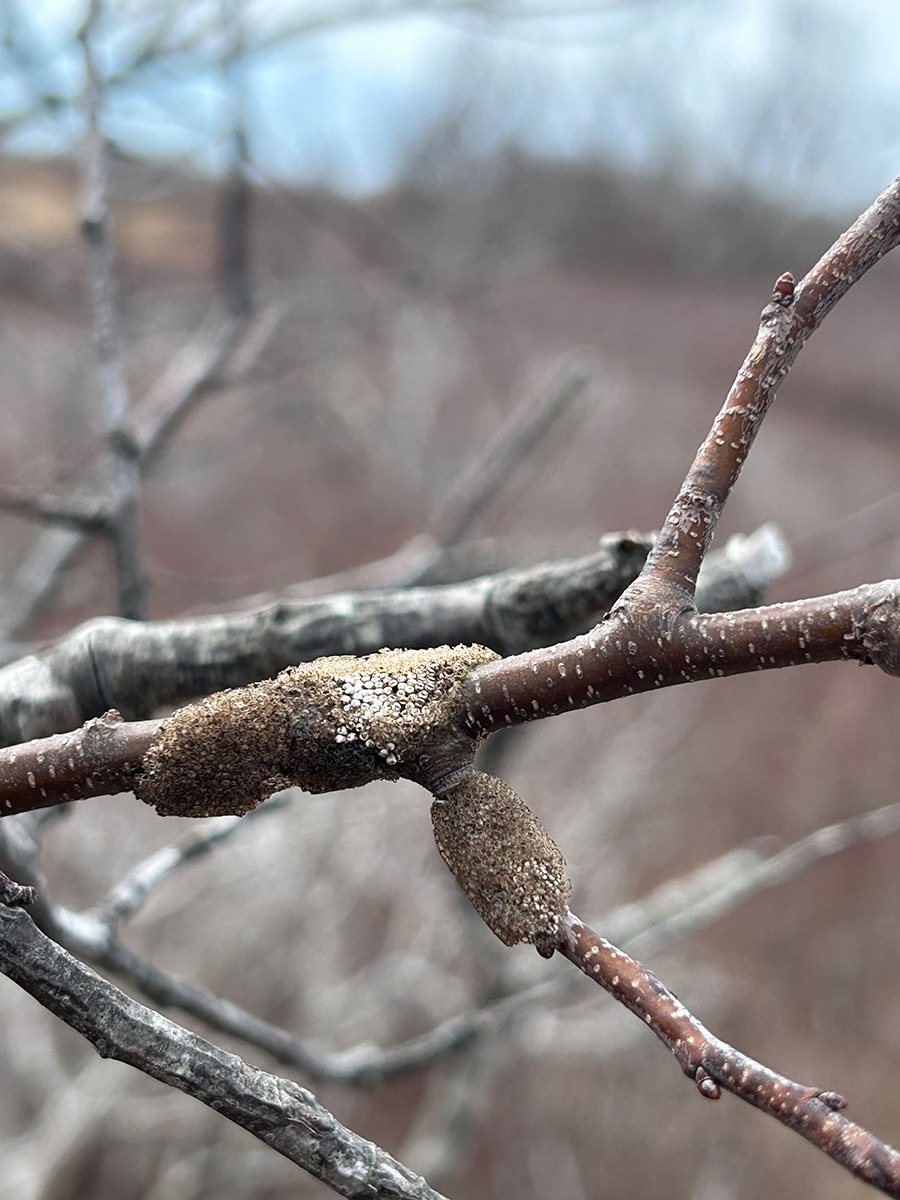
We often get asked about how the cherry trees fare – do the caterpillars kill the tree? I am happy to say that, for the most part, the spring leaf chomping doesn’t harm the tree. A healthy cherry tree can handle a spring pruning. Sure, it takes energy to make more leaves. But a long-lived woody plant can withstand some leaf damage. The damage sustained only “hurts” a tree that is already vulnerable like a young sprout or one weakened by some other stressor. If there were multiple caterpillar boom years in a row, the cherry might be weakened over time. This is where the boom-bust cycle works for the host trees as well. They can replenish their energy reserves in the bust years.
So instead of denigrating these wonderful native caterpillars, let’s admire them during their boom cycle.
In the 1963 Disney movie Summer Magic, Burl Ives sings a song called “The Ugly Bug Ball.” I have that song stuck in my head when I see the plethora of Eastern Tent Caterpillar egg masses this year. It will be an Ugly Bug Ball for sure. And that is really how we should look at this year’s hatch: as a celebration, a caterpillar party!
Here’s what to expect for the rest of Caterpillar Celebration 2026!
Egg Hatch – Anytime from Daffy Weekend to early May the egg masses will begin to hatch. The hatch date is driven by air temperatures, so a good stretch of warm, sunny days could do it.
Tent Construction – The newly hatched caterpillars will start making a tent almost right away. This tent helps them thermoregulate and stay warm during our Nantucket cool springs.
Feasting – Eastern Tent Caterpillars have from hatch day to early June to really beef up and get ready for metamorphosis. This is the time to eat as much as possible. It’s also when the Black Cherry trees are putting out the fresh, young leaves – the most palatable for the caterpillars.
Cocoons at last – By mid to late June, the ETC had gone the way of the Very Hungry Caterpillar and built a cocoon. ETCs usually head to the leaf litter or wood piles hiding their cocoons from interested predators.
Metamorphosis – After being in the cocoon for three weeks, the ETCs emerge as reddish/brown moths. The moth phase lasts only 5 days. In this short time, the females release pheromones, attract a mate, find a host, and lay eggs. No time, or ability, to eat! All eggs are oviposited and then…death.
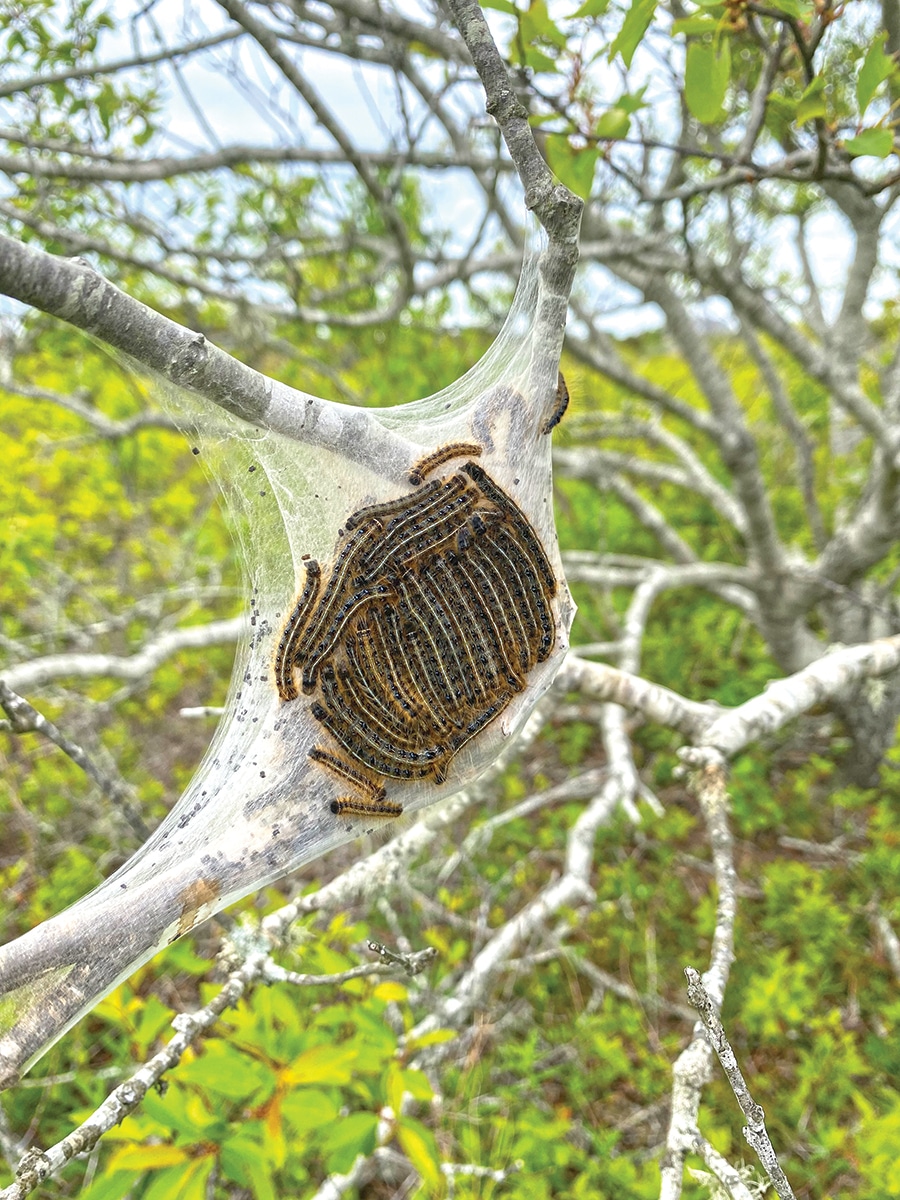
Eggs!!!! Yes, next year’s eggs, which will hatch in spring of 2027, will already be found on our Black Cherries. And so the cycle begins…
Even though I hope we can all learn to appreciate the Eastern Tent Caterpillars, what do you do if you still want to get rid of them in your yard? First of all, you could prevent them hatching by removing the egg masses before hatching. That would involve scraping them off. If you identify where the eggs are, you could remove just the end of those branches. Alternatively, you could put sticky tape on the branch to stick the hatchlings so they can’t eat or travel the tree. Whatever you decide to do, please do not spray insecticide. There are no insecticides that are specific to ETC. So, if you spray for ETC, you will likely kill any bees, butterflies, or other pollinators in your yard. This will also limit birds to your property and cause a trickle down of harm and biodiversity loss.
Happy Eastern Tent Caterpillar Celebration! That does have a nice ring to it.
I’d love to see your caterpillar and tent photos. Share them to stbois@llnf.org or tag us on social media (@loringnatureack and on @nantucket_insider).