



by Steve “Tuna” Tornovish
There’s a wonderful Walt Whitman quote that had my attention today. The esteemed poet, writer, and all-around observer of his fellow humans said, “Be curious, not judgmental.” Sage advice, right?
So how did I come to know this thoughtful quote? No, it’s not due to my amazing scholarship. It’s because this quote was the keystone to one of the most memorable Ted Lasso scenes ever filmed. Ted was challenged to a darts match by the evil and pompous Rupert. Rupert had Ted pegged as an American hillbilly, a rube ripe for the picking. But Rupert should have been more curious and not so judgmental. Ted, it turns out, was left-handed. And had spent his formative years in a sports bar, playing darts while he waited for his father. Ted stomped Rupert, the bar went wild and we gained some valuable insight about the strange and wonderful Coach Lasso.
Today, I got curious. Or more curious. Curiouser? Yeah, I guess I was curiouser about a couple of cool things that are seen in the area of Coatue but not in other parts of the island. The two items in question are the Coatue cactus and what appears to be a Spanish moss. The moss grows only on two cedar trees on Coatue. These two items are quite normal in other places but are unique on the island. How did they get there? And why are they where they are, and not in other places? Hmmmm…
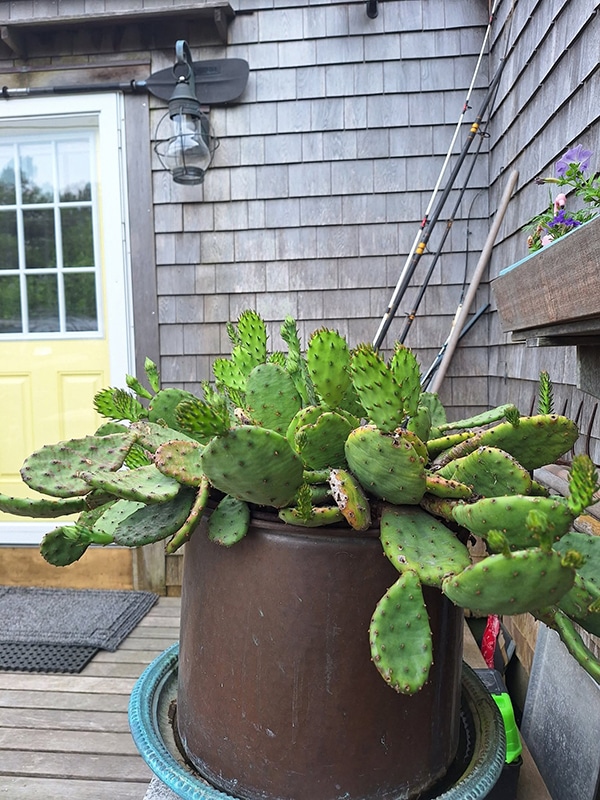
My sparks of curiosity turned into flames when Charles Manghis recently posted a picture of his Coatue cactus, saying, “Caroline the cactus lives outside on my porch year-round and is doing quite well, as you can see.” Yes, she certainly is! Ok, I needed to find out more about the Coatue cactus and pronto. But how? My curiosity grew.
Pondering these questions reminded me of one of my personal quotes (write this one down, kids!): “If you’re not smart, you need smart friends.” And I am blessed to have a smart friend named Burton Balkind, aka Spruce. Spruce is a curious guy. What I mean to say is that Spruce wants to know more about things around him and makes the effort needed to learn those things. Spruce is also a tour guide for the Trustees of Reservations, the organization that manages the Great Point refuge. Thus, Spruce is wholly qualified as a smart friend.
“The Coatue cactus is actually a prickly pear cactus,” Spruce explained. “There’s a couple of theories as to how they ended up on Nantucket. The most plausible theory is that their seeds were carried by birds. So either the seeds landed on the island by defecation or maybe were caught on a bird’s foot.”
So bird poop brought the cactus to the faraway island of Nantucket. Ok, that would work, I guess. But why do they survive and thrive in that area of the island?
“The Coatue sand is super porous and dry. That works for the cactus. The prickly pear cactus like a semi-arid climate. And that’s really what you have in Coatue. The sand won’t retain rain like other soils on the island will. They can thrive because it is like a desert sand.” See? I told you Spruce was smart. “They have a beautiful yellow flower with bright orange in the center. I saw some recently that look almost ready to bloom.”
And then he added this: “Hey Tuna – did you get the book by Peter Brace I told you about? He does an amazing job of explaining things like this.” Now please know that this is the second time that my friend Spruce has recommended that I obtain a book by Peter Brace. Peter is wellknown as a thoughtful man, a thorough researcher, and a very cool guy who has led many Nantucket visitors on island walking tours. Ok, Spruce, I can take a hint. I rolled right on down to Mitchell’s Book Store and purchased Walking Nantucket by Mr. Brace.
I was immediately fascinated by this book. Of course I opened it right up to the section about Coskata Pond, the large estuary that helps define the Coatue section of Great Point. Brace detailed how a huge storm in December of 1896 formed what became known as Haulover Pond. Nantucket fishermen would row up harbor and haul their fishing dories over the narrow spit of land to get to the eastern shore of the island. Well, the storm made that easier for a bunch of years, opening the spit directly to the ocean.
My quest for knowledge about the Coatue cactus got sidetracked as I fell into the rabbit hole in the Coskata Pond chapter that discussed a Native American named Mud Turtle. I won’t spoil the story for anyone, but suffice it to say that Mud Turtle was enamored with the daughter of a chief of another tribe. He courted her the real old-fashioned way—he kidnapped her. The young lady had other plans and hoofed it out of Mud Turtle’s Coskata cave as soon as she could. Mud Turtle ended up with an arrow in his back. Legend had it that his body would not stay buried and that Mud Turtle is still poking around Coatue, looking for his lost love. Great: like I needed one more thing to worry about aside from mosquitoes and potholes when I’m out there fishing at night!
I proudly texted Spruce a picture of my brandnew book. Spruce returned a photo to me with a caption that said, “Wrong book.” He had been referencing another Peter Brace book titled, Nantucket: A Natural History. Oh man! I wasn’t going to fight traffic again, so that book will be purchased on my next sojourn into town. I encourage everyone to pick up your own copies of Peter’s books. The one I bought is captivating, and my smart friend said the same about the next.
Hey Spruce – what about the Spanish moss? “It’s neither Spanish nor moss – it’s a lichen called Old Man’s Beard. It thrives in moist air environments. Our soil is dry, but our air is very moist. Even in super dry conditions there’s still a lot of moisture. There are some more cedar trees between markers 2 and 6 that have it.”
I might have to change that name to ZZ Top moss. It’s certainly reminiscent of the beards sported by Billy F. Gibbons and (the late, great) Dusty Hill. But regardless, my curiosity paid off. I learned a lot about the mysterious Coatue cacti. And the Old Man’s Beard. And the ghost of Mud Turtle. Stay curious, my friends. And thank you to my smart friends like Spruce, Charles Manghis, and Peter Brace.
Steve “Tuna” Tornovish is a Nantucket native who has spent his life fishing from the beaches of his beloved island. He loves to introduce clients to the joy of fishing with his Nantucket Island Fishing Adventures: stevetuna.com