Beetlemania Unearthed
by Sarah Teach
If all the world's insects were to die, every human on the planet would be dead in six months. Think that's a bold statement? Insects are the entities that recycle used materials and put them back into the earth as utilizable substances. Without them, disease would take over; the ecosystem would collapse, and would take us down with it. There ain't no exoskeletons about it; insects are important little buggers!
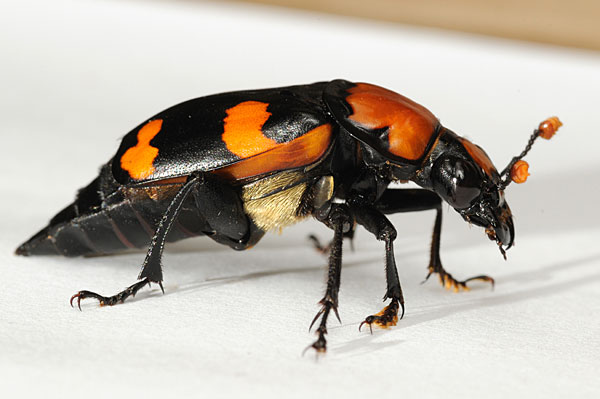
For the past 18 years, Nantucket has been home to a project combating the disappearance of an extraordinary insect: the American burying beetle. Let's go back to 1994, when no one had seen any of these federally endangered beetles on Nantucket since the 1920s. Under the administration of the U.S. Fish and Wildlife Service, Nantucket's own Maria Mitchell Association partnered with Rhode Island's Roger Williams Park Zoo to establish a Species Survival Plan (SSP) for the American burying beetle. One of the world's most powerful tools in combating extinction, an SSP is a program that manages the breeding of a species with the end goal of a self-sustaining species. Each year, the Roger Williams Park Zoo sends over their foremost beetle specialist and Director of Conservation Programs, Lou Perrotti, for one full month to study and augment the progress of the burying beetle's reproduction on the island. Perrotti also serves as the Species Coordinator for the American burying beetle SSP for the Association of Zoos & Aquariums across the nation. So far since this SSP's implementation, more than 2,800 burying beetles were released at several specified locations over the island's 48 square miles. Perrotti explains, "Nantucket is not deforested or grazed; it's the perfect habitat for the American burying beetle." This is not even to mention that the island is home to plenty of small animals that the burying beetle finds simply delicious!
The American burying beetle (Nicrophorus americanus), at 1.5 inches in length, is the largest member of the family of carrion beetles, which feed on carrion, also known as the decaying flesh of mammals, birds and reptiles. The "burying" part comes into play when a beetle is driven to become a mom or dad. Step one is to find a mate; step two is to find a carcass that weighs between 80 and 180 grams. This often means the dead body of a quail, a small rabbit or a chipmunk. Within 24 hours, that carcass is interred underground, hidden from other creatures that might also wish for such a delightful feast. Perrotti puts this into perspective: "It would be the equivalent of you and I getting an RV and then, by hand, totally burying it in the dirt, overnight." Once underground, something amazing happens. The beetles work hard to tear off all of the fur or feathers from the carcass and then transform the carcass into a hollow, baseball-sized house where the female lays eggs. The burying beetle has a tender side, too. It is one of the only insects that exhibit biparental care. Generally, parental care is seen in social insects like bees and ants; but even out of those few species, the burying beetle shows one of the highest levels of this intensity of care. The mom and dad beetle cooperate to prepare a resource for their offspring. Burying beetles don't believe in ordering take-out; they plan at-home meals ahead of time. Mom and Dad leave plenty of carrion stuck to the round house's insides so that their young will have food as soon as they are hatched. When those sweet little things do emerge - white, worm-like larvae with faces that only a mother could love - the parents chew food then regurgitate it in liquid form to feed the babies. As you might imagine, this critter does not exactly smell like flowers and sunshine. "They're chemical factories," says Perrotti.
You might wonder why so much effort is being put into saving this single species of beetle that, quite frankly, seems rather gross. Perrotti says, "People always focus on the megafauna. And of course, it's important to save the gorillas and the pandas. But the burying beetle, although it's not very sexy, is a very important part of the ecosystem." Perrotti directs attention to the wheel of a bicycle. "You pluck one spoke from that wheel. Nothing's going to happen. You pluck two; it might warp a little but you'll still be able to ride it. But you start plucking too many and it's going to collapse. That's exactly what we do to the earth. We just kind of kick it once in a while. But we owe it to that wheel that's been carrying us to take it into the shop sometimes and get those spokes put back on." Perrotti has seen improvement over the past several decades. "I think we're entering an age now where people are paying attention to conservation and being aware of the earth's fragility. Especially on this island." However, Perrotti recognizes that not everyone is going to love snakes, spiders and burying beetles; so he has some advice for those of us who might still find it difficult to appreciate them: "You have to step back and look at it all as being beneficial. Take the human out of the picture. From the tiniest ant to the massive whale shark," he says, extending his arms sideways, "This has happened time and time again. A lot of animals lose their lives simply due to [humans'] lack of education."
The project to save the American burying beetle has garnered accolades of the finest kind starting in 2000 with the Association of Zoos and Aquariums (AZA) North American Conservation Award, and then going on to secure the AZA Top Ten Conservation Success Stories in 2006, along with the prestigious AZA Edward H. Bean Award, which in 2006, the project was selected as the national leader of the beetle's Species Survival Plan. According to the Roger Williams Park Zoo's website: "This effort is the longest on-going reintroduction program for this species and is probably one of the most intensive endangered insect recovery efforts in the United States. It is one of the few successful invertebrate reintroductions in the world." (http://www.rwpzoo.org/143/american-burying-beetle-repopulation-project accessed August 7, 2012).
 As you might imagine, one does not become the SSP Coordinator for a national program without some background with animals. Perrotti's relationship with animals began during his early childhood in Rhode Island. "Until my family moved to the country, my only experience with snakes was in books. But I just loved them, I couldn't learn enough about them!" Perrotti's eyes widen as he gazes off, remembering. "I'll never forget that first time I saw that snake coiled in the sun." He snaps out of his daze. "I just had to have it!" Perrotti exclaims. "I grabbed it right away. Luckily it was just a garter snake. Not venomous." He shakes his head. One might presume that Mom Perrotti may not have been too pleased with her blooming young biologist's slithering acquisition, but Perrotti tells a different story: "I had very, very supportive parents. I got my first boas when I was 10. I learned to breed them. Then in my adult life, I bred snakes privately for many years. I led education programs for kids in schools, and I got pretty well known for it. When the Roger Williams Park Zoo had a position open up for a keeper, it required reptile experience and I had that. Usually people that keep inverts tend to keep reptiles," he says, using zookeeper slang for invertebrates. "So I got the job and started working with birds, mammals and primates along with the reptiles and the inverts. And this," he says with a cheerful grin, "Was when I got really interested in insects."
Even if it took until adulthood for Perrotti to become a "bug guy," he certainly always had a dream for his future. "When I was a kid, I used to see all these amazing places in National Geographic," he says, pointing at the imaginary magazine in his lap, "And I hoped to one day be one of those people that go to these places." A couple of decades later, Perrotti has returned from many biological research trips through the most remote parts of Papua New Guinea bearing stories both gruesome and heartwarming. When asked to share some of these stories, Perrotti stares at a spot on the ceiling for a good 10 seconds, a slow grin spreading across his face, before he says, "Most of them are not publishable!" Soon, however, Perrotti throws a bone with a biting flavor: "I've had leeches stuck in the backs of my eyeballs. When you're walking through a rainforest and the rain is pouring down on your face, you can't tell the difference between a big raindrop and a leech falling from the vegetation above you."
When asked about his educational background, Perrotti chuckles a little bit and leans forward in his chair. "I was educated at the school of hard knocks. People in my field are all PhDs, so when I go to all these conferences, it's kind of embarrassing sometimes. But then again, a lot of people recognize that I got here on passion. And," Perrotti adds with a shrug and a few nods, "you can't be a moron in this field, that's for sure. I have always had a constant thirst for new knowledge. And I've always been a fan of creepy crawly things. So when I had the chance to get involved with the burying beetle, I saw the opportunity to be an advocate for these types of species. I am very thankful to Roger Williams Park Zoo for the ability to do cutting-edge work alongside a wonderful, dedicated team of people. Saving this species really is a team effort. And we feel like we're setting a trend."
Fortunately for Nantucket, Perrotti's passion for "creepy crawly things" has been a huge influencing factor in the resurgence of a species that is integral to human existence. You too can help save the American burying beetle by following its example: recycle your used materials! In doing this, you are helping the earth grow back into a clean and healthy habitat for the burying beetle, and in turn, a much more healthy habitat for yourself. To learn more about the collaborative effort between the Maria Mitchell Association and the Roger Williams Park Zoo to save the American burying beetle, visit mmo.org or rwpzoo.org.